


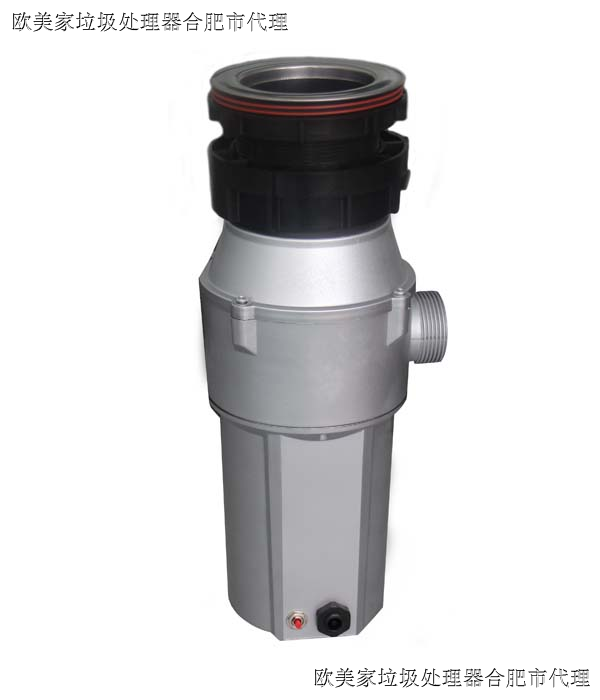



Some people are concerned: Could food waste particles clog the sewer system?
Relevant authorities say the likelihood of sewer blockage is very low.
If this technology is to be widely adopted, it would be wise to first conduct pressure tests on the sewage system.
Beautiful Hangzhou Lab—Follow-up Report on the Pilot Program for Food Waste Disposers in Jiangxi Garden
Related report: Another 400 households in Wangjiang Subdistrict will soon receive the new devices free of charge.
Not long ago, our newspaper published a report on food waste disposers, sparking interest and lively discussion among readers. This newly emerging kitchen gadget has captured many readers’ attention with its environmental friendliness and convenience. However, some readers also wonder: Although food waste disposers “look great,” could they potentially have adverse effects on the environment?
Mr. Lu from Hangzhou called our newspaper’s contact number, expressing his concern: Once we start using these disposers at home, as soon as we turn on the water, food waste gets flushed directly into the sewer. If every household installs one, the sewers will surely become blocked. While the small-scale environment at home might improve, could this lead to pollution of the larger urban environment?
Mr. Lu said: “What if the food waste starts fermenting in the sewer? I think the current capacity of sewage treatment plants might struggle to cope. If disposers become widespread, sewage treatment plants and pipelines will definitely need upgrading, which would entail substantial costs.” Therefore, he believes that we shouldn’t promote them blindly.
Other readers expressed strong support for the convenience of food waste disposers, but their main question remains: Could food waste particles clog the sewer system?
Generally, the pipes won’t get clogged.
To determine exactly how much of an impact there might be, we’ll need quantitative measurements.
With these questions from our readers in mind, we specifically consulted relevant experts from the Municipal Urban Management Committee.
“This type of disposer is more commonly used abroad, but rarely seen domestically,” said a responsible official from the Drainage Division. Currently, the diameter of sewage pipes in Hangzhou’s residential communities typically ranges from 150 to 200 millimeters, while municipal pipes outside the communities can reach up to 300 millimeters in diameter. After being crushed, food waste particles become extremely fine, making it unlikely that they’ll directly block the pipes.
However, he also pointed out that since this technology hasn’t been widely used yet, it’s still too early to say what potential negative impacts might arise. If large-scale adoption is planned, thorough research must be conducted—after all, this is a completely new addition to the city’s sewage network.
“If a large amount of waste powder enters the sewage pipes, it’s equivalent to an increase in the concentration of wastewater, meaning the treatment processes would need to be upgraded accordingly. At present, the construction of urban sewage recycling systems hasn’t taken into account the scenario where food waste ends up in the sewer after being processed. Without adequate preparation, this could raise the maintenance costs of the sewage recycling system.”
He particularly noted that, from the perspective of pipeline maintenance, if a large number of households in a community start using food waste disposers, the potential “trouble” could come from the accumulation of waste particles at pipe bends, which would increase the community’s pipeline maintenance expenses.
As for whether food waste disposers can be widely promoted, his opinion is that, currently, Zhejiang Province hasn’t seen large-scale adoption of this waste disposal method. It would be best to carry out precise calculations during pilot programs to see whether this could put additional strain on the city’s sewage system.